
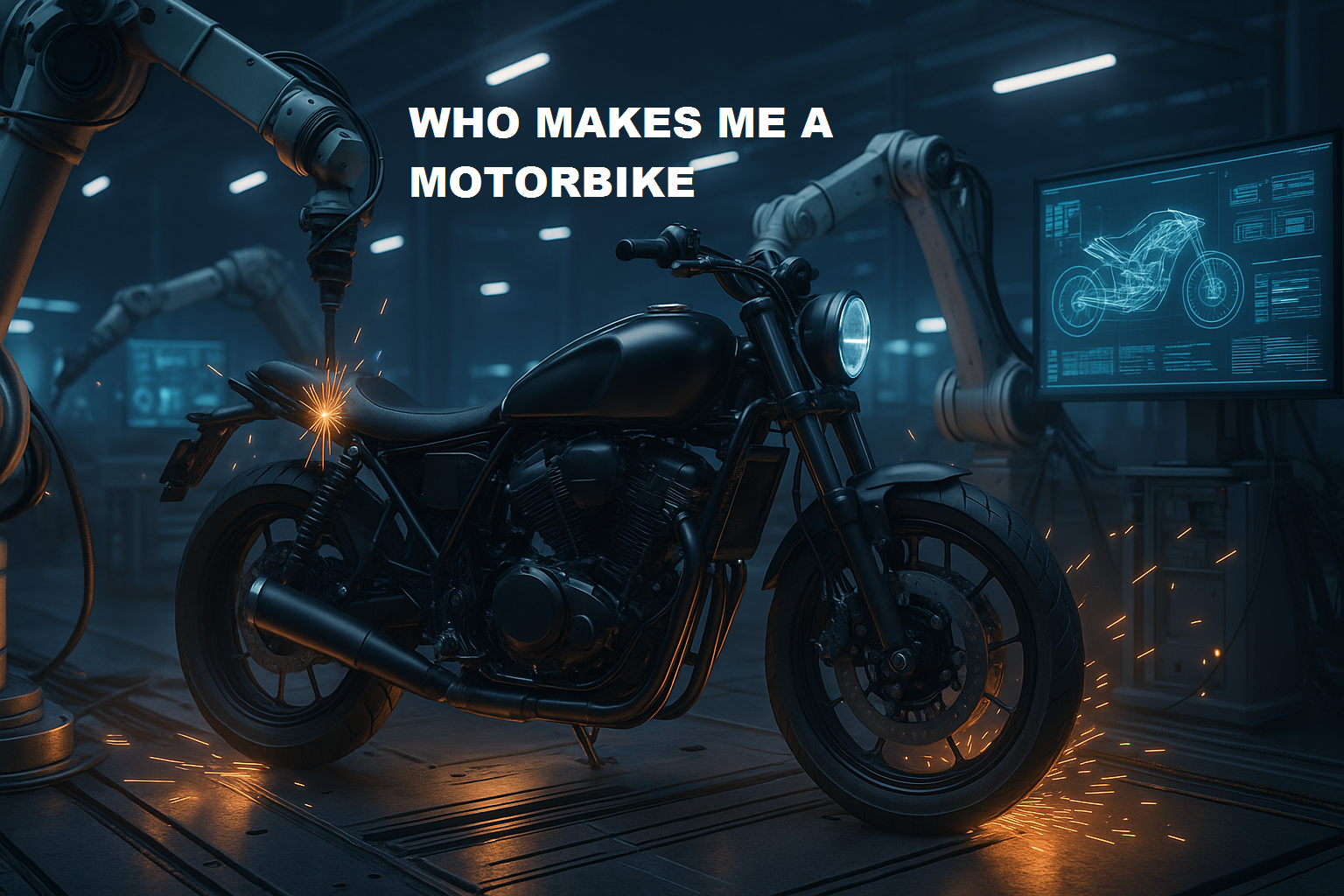
When people talk about Artificial Intelligence “taking over,” the image is often painted in extremes — a world where machines do everything, and humans drift in a haze of leisure or irrelevance. But let’s make this real, with a simple, grounded question:
Who makes me a motorbike?
It sounds playful, but it cuts right to the heart of the debate.
From CAD Screen to Factory Floor
Today, AI already helps design vehicles. Generative software can optimise frames, suspension, even aerodynamics better than human engineers. In car and bike factories, robots already weld, paint, and assemble with astonishing precision.
But the picture isn’t complete. Humans still run the supply chains. Humans mine the ores, refine the metals, shape the plastics, and stitch the wiring looms. Humans step in when parts don’t align, or when unpredictable tasks crop up.
So in 2025, if you asked AI to “make me a motorbike,” the truth is this:
- It could sketch one for you in dazzling CAD detail.
- It could help a factory’s robots put it together.
- But the hidden layers — raw materials, logistics, messy edge cases — still rest heavily on human shoulders.
Projecting Forward: The Timeline
Realistically, here’s how far we are from AI/automation handling the process end-to-end:
- 2035: AI designs and assembles bikes from supplied parts in fully automated factories.
- 2050: Recycling and local “fab hubs” allow bikes to be built on-demand with minimal human labour.
- 2070: Cradle-to-cradle loops mean machines manage most of the supply chain, from raw material extraction to assembly.
- 2100: Full autonomy. Given resources and energy, AI can design, source, fabricate, assemble, and deliver a motorbike — no human labour needed.
So yes, by the end of this century, it’s plausible that AI could build you a motorbike from raw goods. And if it can do that, it can do almost anything else.
The Fork in the Road
This is where the metaphor matters.
If AI and automation can one day build you a motorbike from scratch, then they can also grow food, construct houses, deliver healthcare, and create art. At that point, humanity faces a stark choice:
- Option One: Keep the Hamster Wheel.
We restrict automation, keep most people tied to wage-labour, and continue the endless spin of work–wages–debt–consumption. A few benefit from AI, but most still grind. - Option Two: Step Into Advancement.
We allow AI to free us from mundane labour, and redirect human energy toward exploration, art, science, philosophy, care, and creativity. The daily struggle to survive gives way to a collective effort to advance.
What Really Holds Us Back
The obstacle isn’t whether machines can do the work. Give it until 2100 and, barring catastrophe, they almost certainly will. The obstacle is whether we — as one species — can agree on what to do with that freedom.
Will we cling to old models of profit and debt, keeping the hamster wheel spinning long after it has stopped making sense?
Or will we step off the wheel, and take the time dividend that technology offers, to advance humanity itself?
Closing Thought
The “Who makes me a motorbike?” question reminds us how far we still have to go, but also how close we might be, within a century, to ending labour as we know it.
That leaves only the bigger question: what kind of species do we want to be, once survival no longer chains us to the wheel?
“Hope isn’t what they promise you. It’s how you carry on when they don’t deliver.” — Dave Carrera


