
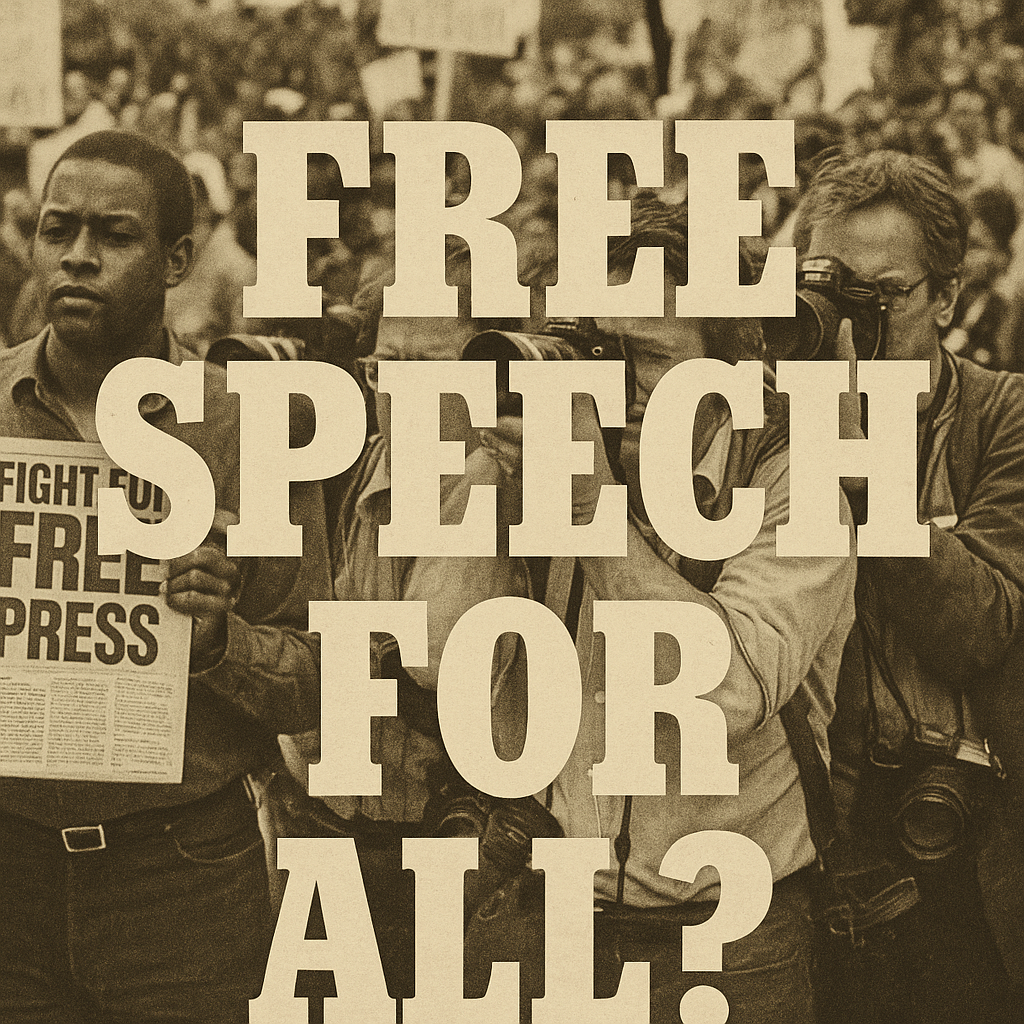
Could the world handle American-style free speech?
The First Amendment to the U.S. Constitution — written in 1791 — has been described as the strongest protection for free expression in the world.
It guarantees:
- Freedom of speech
- Freedom of the press
- Freedom of religion
- The right to assemble
- The right to petition the government
And crucially, it stops governments from interfering with those rights.
This means that in the U.S., even offensive or controversial opinions are protected — a model that would be unthinkable in many other parts of the world.
Why It Would Be Transformative Globally
If the First Amendment became a global human right, the impact would be seismic:
- Dissent would be protected. Protesters could challenge governments without fear of arrest.
- Journalists could report more freely. Investigative journalism wouldn’t be crushed by “insulting the state” laws.
- Censorship would collapse. From social media bans to “fake news” crackdowns, many tools of authoritarian control would vanish.
It’s a shield for the unpopular, the whistleblower, and the truth-teller.
Why It’s So Difficult
But here’s the catch — many nations wouldn’t accept it.
- Conflicting laws: Many European countries criminalise hate speech, Holocaust denial, or religious insults. A First Amendment model would overrule these laws.
- Cultural differences: In the U.S., the right to offend is fundamental. In Europe or Asia, speech is often balanced against “dignity” or “social harmony.”
- Enforcement: Even if the UN adopted it tomorrow, who would enforce it? What court could make China, Russia, or Saudi Arabia comply?
What We Have Now
The Universal Declaration of Human Rights (Article 19) already says:
“Everyone has the right to freedom of opinion and expression… to seek, receive and impart information and ideas through any media and regardless of frontiers.”
Sounds good? Here’s the problem: it includes broad exceptions for morality, public order, and national security.
Those exceptions are exactly what many governments use to silence dissent.
Could It Actually Work?
In theory: Yes. A rewritten global Article 19 — with far fewer loopholes — could put First Amendment-level protections into international law.
In practice: Hardly. It would require rewriting how entire legal systems approach speech.
And some of the biggest players — including countries currently on the UN Human Rights Council — would fight tooth and nail to stop it.
Final Thought
The First Amendment is uniquely American because it treats freedom of expression as almost absolute.
Turning it into a global human right would empower billions — but it would also collide head-on with the way most of the world balances speech against “social good.”
It’s bold. It’s liberating. And it would be one of the biggest legal battles in modern history.
Hope isn’t what they promise you.
It’s how you carry on when they don’t deliver.
— Dave Carrera


