
For a long time now, I have felt completely and utterly disillusioned with both of Britain’s dominant political parties.
Labour no longer feels like a party of working people or structural courage.
The Conservatives no longer feel conservative in anything but name.
So when Reform UK began to rise, I was — genuinely — tempted.
Tempted by the word itself.
Reform.
Tempted by the idea that maybe, finally, something was emerging that was prepared to challenge the political culture rather than simply inherit it. A movement that might not just argue over policy, but question the machinery that keeps producing the same failures.
I wanted Reform UK to be exactly what its name implied.
But the more I looked — not at the slogans, but at the people, the pathways, and the political DNA — the more that temptation collapsed.
Because what became clear is this:
Reform UK is not reforming British politics.
It is reforming the Conservative Party.
And that is a very different thing.
What exactly is being reformed?
For a party built around the word Reform, it is reasonable to ask a very simple question:
What exactly is being reformed?
Not rhetorically.
Not emotionally.
But structurally.
Because when you look beyond the branding, the social media tone, and the positioning, something very specific becomes hard to ignore:
Reform UK is made up overwhelmingly of former Conservative MPs, advisers, and figures who grew up inside the Conservative political system.
There has been no meaningful flow of former Labour MPs into Reform.
No emergence of a new political class.
No institutional outsiders arriving to redesign how politics itself works.
What we are seeing is not the birth of a new political tradition.
We are seeing a reorganisation of an existing one.
Which leads to an uncomfortable but necessary conclusion:
Reform UK is not reforming British politics.
It is reforming Conservatism’s route back to relevance.
The people tell the story
Political movements reveal their true nature not by their slogans, but by their personnel.
If a party were genuinely reformist, we would expect to see at least some of the following:
• New political backgrounds
• New institutional thinking
• Cross-party migration
• A challenge to how power itself is organised
• Figures who were never part of the governing machine
Instead, what we see is familiar.
Former Conservative MPs.
Former Conservative office-holders.
Former Conservative loyalists who broke with the brand, not the political culture that produced them.
This matters, because political culture is not something you shed by changing a logo. It is learned. It is internalised. It shapes how power is viewed, how problems are framed, and how solutions are limited.
If most of the architects are products of the same system, expecting a fundamentally different structure to emerge is optimistic at best.
A new vehicle, not a new direction
Reform UK does not challenge:
• The professional political class
• Centralised party control
• The funding and donor ecosystem
• The career-ladder model of politics
• The revolving door between state and influence
• The way Parliament itself operates
What it offers instead is a sharper version of familiar Conservative-era arguments:
Immigration.
Net zero scepticism.
Tax.
Regulation.
Culture war politics.
These are not reforms of political life.
They are policy disputes inside an unchanged political framework.
They change which levers are pulled, not who designed the machine.
And that distinction is crucial.
True reform threatens systems.
This threatens mainly branding.
The uncomfortable pattern
There is a pattern modern politics keeps returning to.
When trust collapses, parties do not dismantle the structures that failed.
They repackage the people who operated them.
New movement.
New name.
New tone.
Same political class.
Reform UK fits this pattern almost perfectly.
It allows Conservatism to:
• Reset its public image
• Disown its governing record
• Re-enter politics as insurgency rather than authority
• Test harder positions outside the main party
• Absorb anger without owning responsibility
In practical effect, Reform operates less like a reform movement and more like an external pressure wing of Conservatism — reshaping it from the outside.
That is not reform of the country.
That is reform of the Conservative ecosystem.
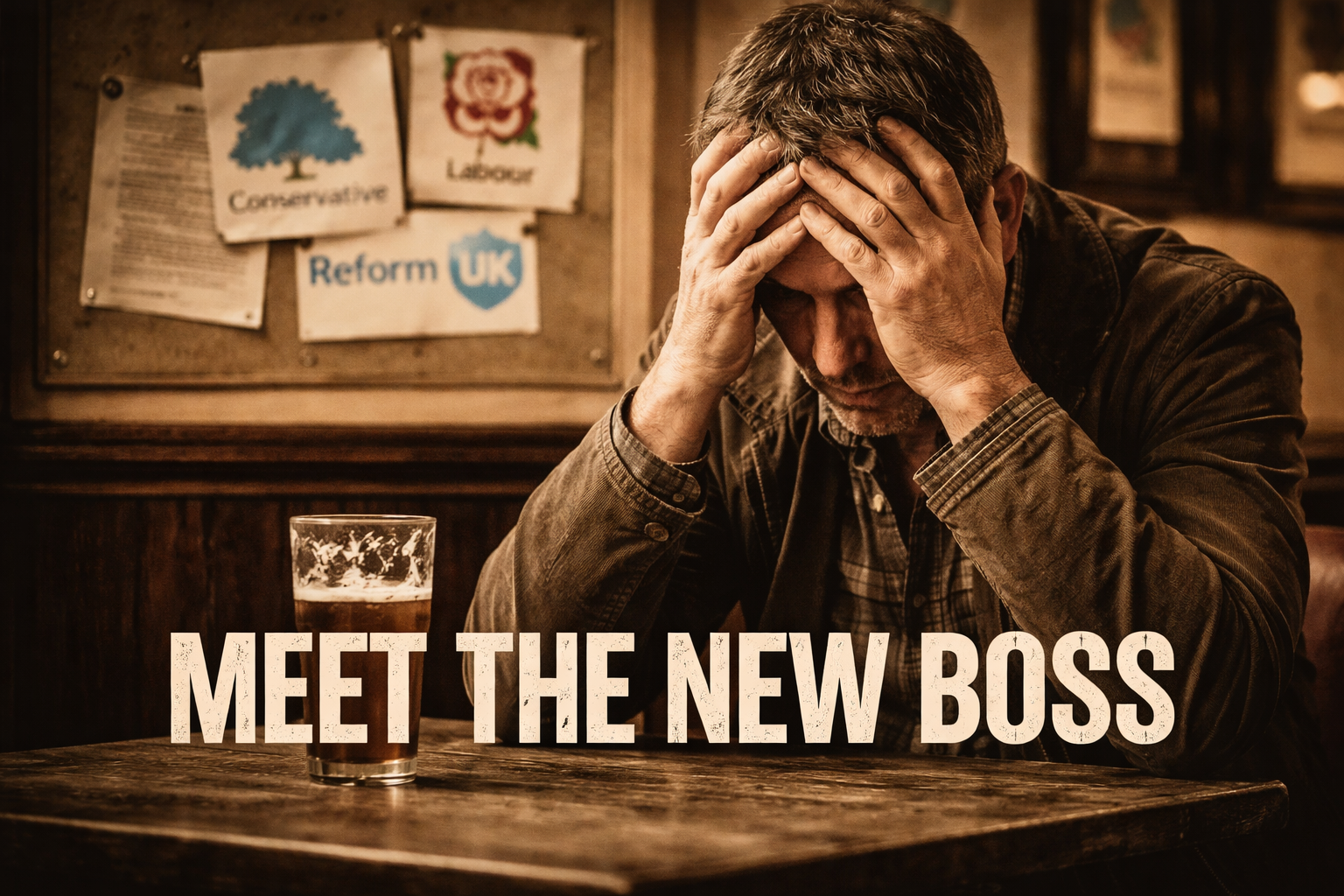
“Meet the new boss…”
The old lyric fits uncomfortably well:
Meet the new boss. Same as the old boss.
Because when the same political class migrates, reorganises, and re-emerges, what the public is being offered is not renewal.
It is rotation.
The language changes.
The tone hardens.
The aesthetic resets.
But the governing culture remains.
And if reform never turns inward, never questions the political class itself, never redesigns how power is built, rewarded, and protected, then the word reform is doing almost all the work.
So what is actually being reformed?
Based on evidence rather than branding:
• The Conservative Party is being reshaped
• Conservative positioning is being recalibrated
• Conservative voters are being reorganised
• Conservative politics is being repackaged
What is not being reformed is the deeper machinery of British politics.
The professional class remains intact.
The career pathways remain intact.
The institutional incentives remain intact.
The house is the same.
Only the sign above the door has changed.
The question beneath the argument
The real question is not whether Reform UK is sincere.
The real question is whether a political class can meaningfully reform a system that created it.
History suggests genuine reform almost never comes from within the structures that benefit from the existing order. It comes when power itself is forced to change shape.
Until that happens, we are not watching reform.
We are watching rearrangement.
And rearrangement, however loud, however angry, however emotionally satisfying, is not the same thing as renewal.
If reform never threatens the political class,
then the political class is not being reformed.
Hope isn’t what they promise you. It’s how you carry on when they don’t deliver. — Dave Carrera


