
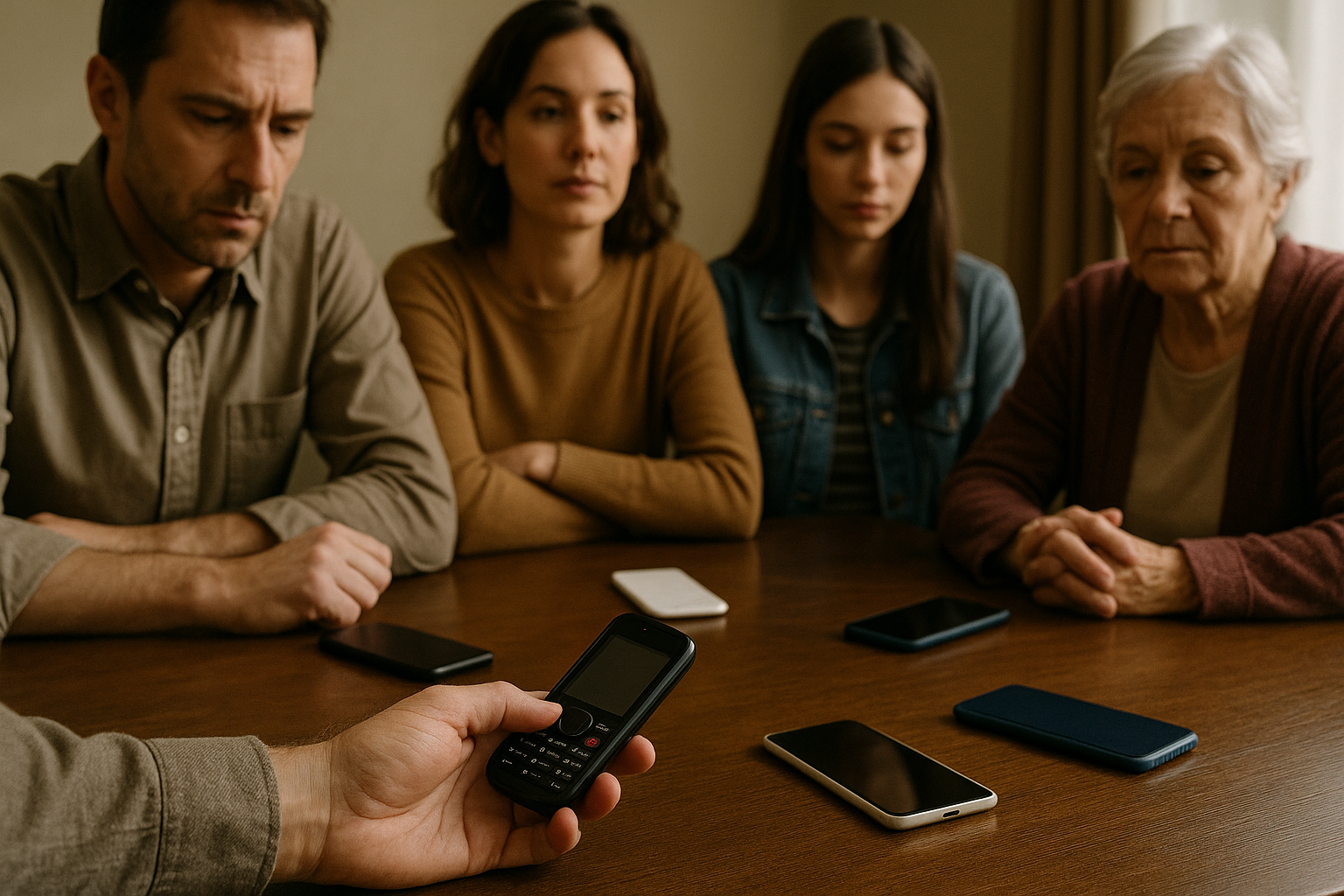
For years we’ve been told that the smartphone is essential. That without it we’re uninformed, unsafe, unconnected, or somehow falling behind. It has quietly become the most normalised piece of State-level technology ever made, handed over willingly, carried everywhere, and checked hundreds of times a day.
But what if the world took a breath?
What if, instead of 7 billion internet-connected screens, we had something closer to 4 billion actual human users? And what if every one of those 4 billion traded their glass rectangle for something simple. Something human. Something like the humble Nokia that does calls and texts, and not much else.
Let’s play that scenario out. Not as fantasy. As a healthy thought experiment.
The Attention Reset
Smartphones are designed to capture and hold our attention. They compete for it. They carve it up. A feature phone doesn’t. Suddenly notifications vanish. Social media disappears. The constant flicker of something new to check simply stops.
Screen time drops from hours to minutes.
For billions, that shift alone would change how they sleep, how they concentrate, and how present they are with the people around them. Half the world would go from “always half somewhere else” to being fully in the room again.
A Global Breath Out
There’s a growing mountain of evidence linking heavy smartphone use to anxiety, insecurity, comparison, insomnia, and an inability to switch off. If 4 billion people stepped back from all of that, the effect would be profound.
Imagine entire societies with:
- calmer days
- fewer arguments
- less spread of manufactured outrage
- more conversations
- less social media comparison
- real connections instead of curated ones
A quieter world doesn’t mean a smaller one. It means a healthier one.
Work Stops Following You Home
Smartphones erased the boundary between work and life. Emails, messages, alerts and expectations travel with you everywhere.
A 4 billion-strong switch to basic phones would slam that door shut.
Work would once again stay where it belongs. Evenings and weekends would return to normal people. Family dinners would stop being interrupted by lights buzzing on the table. And many workers, for the first time in years, would know what it feels like not to be “on call” around the clock.
The Great De-Algorithmisation
Social media giants would not survive a shift like this.
Neither would influencer culture.
Nor the constant drip-feed of synthetic outrage.
Without endless scrolling, the oxygen feeding these systems disappears.
It doesn’t create silence. It creates clarity.
People would talk to each other again. Neighbours, family, colleagues, strangers. Real interactions, not filtered ones.
Navigation Becomes a Skill Again
Without phones directing them turn by turn, billions would rediscover the simple pleasure of looking at signs, reading maps, and actually learning where places are.
Spatial awareness would improve. Curiosity would return. People would stop staring at screens telling them where to go and simply look up.
A global reconnection to the world under our feet.
The Environmental Win Nobody Talks About
A Nokia can last a decade. A smartphone is lucky to see three years.
Lithium, rare-earth metals, giant batteries, constant upgrades—gone or drastically reduced.
Billions of people switching would create:
- less waste
- fewer mined materials
- less energy consumed
- longer-lasting devices
A practical win, achieved through simplicity, not legislation.
Freedom From the Pocket Surveillance Device
Smartphones are the perfect tracking tools.
Basic phones… are not.
No app-level tracking.
No passive monitoring.
No behavioural profiling.
No push-driven manipulation.
Billions stepping away would take half the surveillance infrastructure of the modern world with them.
That alone would transform our relationship with governments, corporations and the systems that quietly watch us.
Life Becomes Human Again
Here’s the most important outcome of all.
Life slows down to a pace that feels familiar.
People look up.
They notice things again.
They talk again.
They breathe again.
The idea isn’t to reject technology. It’s to use it with intention.
Just like riding a Vespa and reading road signs, it’s about choosing a life where you aren’t being pulled from the present every ten seconds. A life where your tools serve you, not the other way around.
A Simple Call to Action
You don’t need to give up your smartphone to feel some of this.
Start small.
Pick certain hours where it stays in another room.
Turn off notifications you don’t need.
Put it away at meals.
Let some things wait until you get home.
Treat digital tasks as tasks—not as constant background noise.
Reclaim a little peace.
Reclaim a little space.
Reclaim a little of yourself.
Small boundaries can change a life.
And the people around you will notice.
“Hope isn’t what they promise you. It’s how you carry on when they don’t deliver.” — Dave Carrera


